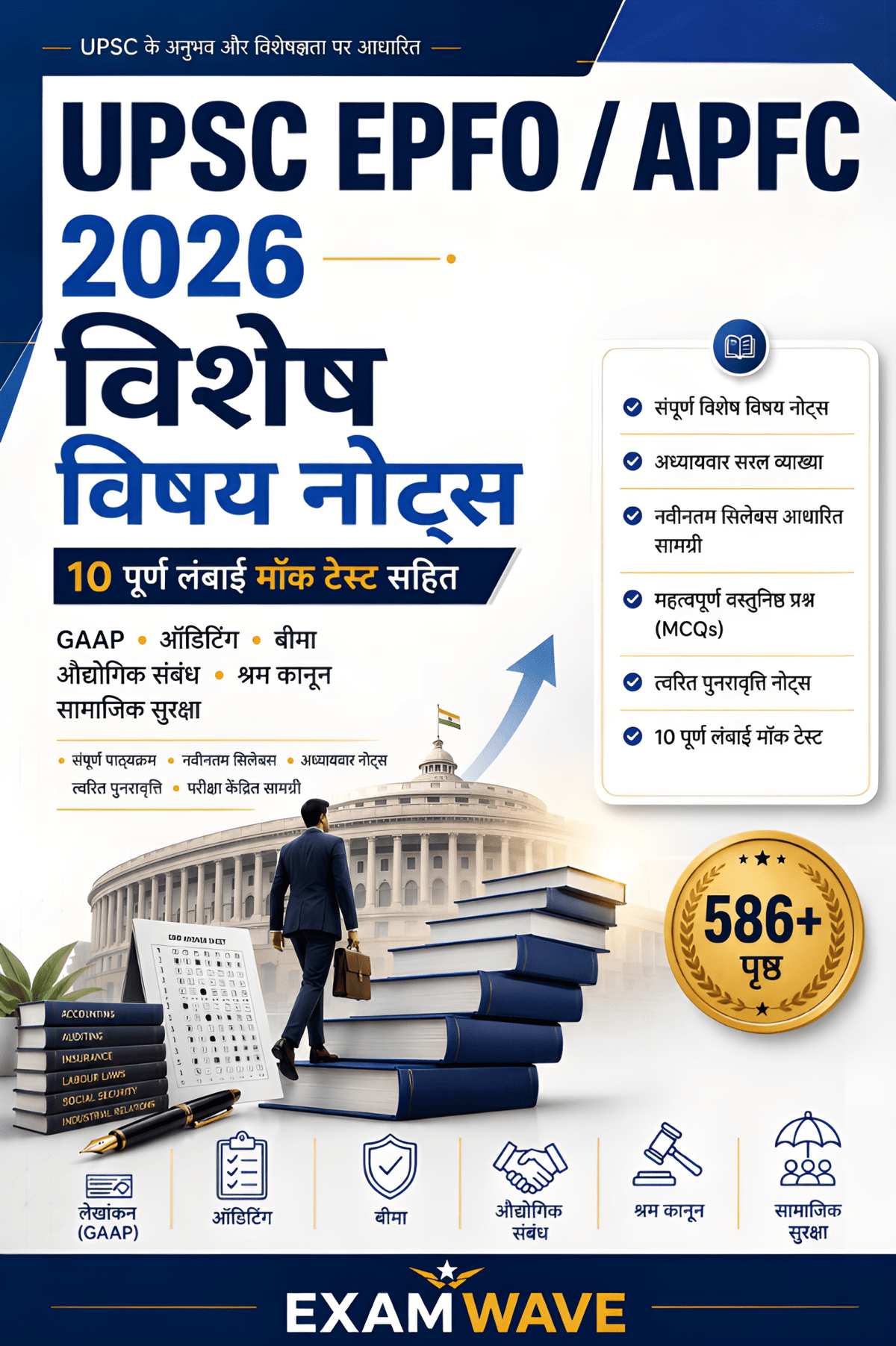
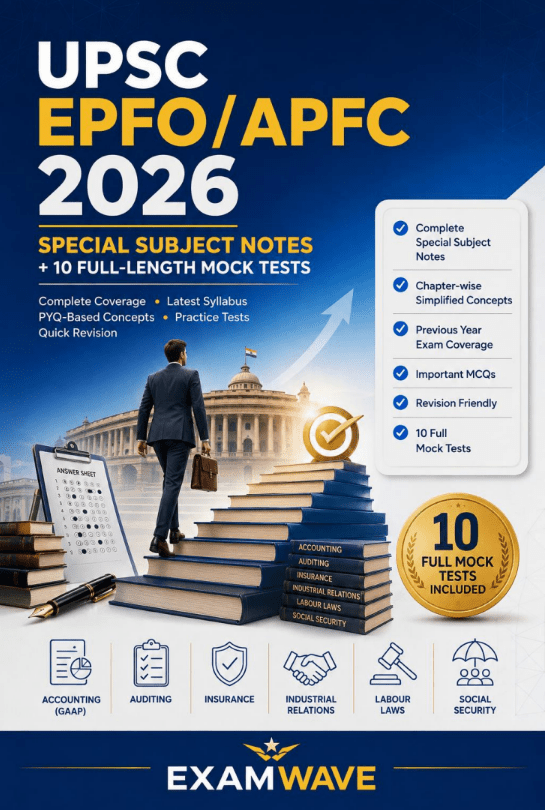
UPSC APFC 2026 Preparation Strategy: A Practical Roadmap to Crack the Exam
The UPSC EPFO Assistant Provident Fund Commissioner (APFC) examination requires more than simply completing the syllabus. The real challenge is managing a wide range of subjects, revising them repeatedly, solving quality questions, and maintaining accuracy under exam pressure.
A good preparation strategy should therefore be structured, realistic and practice-oriented. Instead of trying to study everything at once, candidates should focus on high-priority areas, regular revision and continuous testing.
Understand the APFC Exam First
Before starting preparation, understand the examination requirements, syllabus and question pattern mentioned in the latest UPSC recruitment notification. UPSC publishes recruitment advertisements and related examination information through its official website, so candidates should always verify dates, eligibility and the final scheme from the official source.

The APFC syllabus broadly combines General Ability, General Awareness, Indian polity and economy, history, geography, science and technology, current affairs and specialised areas related to labour, social security and administration.
This makes APFC different from an examination where preparing one or two subjects is enough. You need both breadth and depth.
Step 1: Divide the Syllabus into Three Groups
A practical way to begin is to divide your preparation into three categories.
1. High-Priority Subjects
Give maximum attention to the specialised and highly relevant areas:
- Labour Laws
- Social Security
- Industrial Relations
- Accounting and Auditing
- Insurance
- General Accounting Principles
- Important provisions and labour-related institutions
These subjects can differentiate your preparation because many candidates focus heavily on only General Studies.
2. General Studies
Build a strong foundation in:
- Indian Polity
- Indian Economy
- Modern History
- Geography
- Science and Technology
- General Knowledge
Do not try to study every topic with equal depth. Prioritise areas that have stronger relevance to the examination and revise them frequently.
3. Current Affairs
Current affairs should not be treated as a separate subject that you study only at the end.
Focus particularly on:
Government schemes, economy, labour and employment, social security, important reports, international developments, science and technology, environment and major national developments.
The UPSC's examination ecosystem also shows the importance of current events and broad general awareness in its competitive examinations.
Step 2: Follow the 60–30–10 Rule
A simple allocation can make preparation easier:
60% — Core subjects and concepts
30% — MCQs, PYQs and mock tests
10% — Current affairs and quick revision
The exact ratio can change according to your strengths, but one principle should remain constant:
Studying without testing is incomplete preparation.
After finishing a topic, immediately solve questions from that topic.
Step 3: Make Previous Year Questions Your Guide
Previous Year Questions are one of the best ways to understand UPSC's approach.
While solving PYQs, don't just check whether your answer is correct. Analyse:
- What concept was tested?
- Was the question factual or conceptual?
- What type of options were used?
- Was there a statement-based approach?
- Which topic did the question originate from?
This helps you understand how UPSC asks questions, rather than simply memorising information.
UPSC maintains an official Previous Question Papers section, which should be used as the primary source for authentic PYQs.
Step 4: Use a Smart Daily Study Routine
A complicated timetable is not necessary. A consistent routine is more effective.
Example Daily Plan
Session 1 – 2 hours
Core subject
Session 2 – 1.5 hours
Second subject / General Studies
Session 3 – 1 hour
Current Affairs
Session 4 – 1 hour
MCQs + PYQs
Session 5 – 30 minutes
Revision of everything studied that day
The important thing is not the exact number of hours.
The important question is:
How much of today's study will you remember after seven days?
That is why revision is essential.
Step 5: Follow the 1–7–21 Revision Method
A simple revision cycle can dramatically improve retention.
First Revision
Revise the topic the next day.
Second Revision
Revise it again after 7 days.
Third Revision
Revise it after approximately 21 days.
During revision, don't reread the entire chapter every time.
Use:
Short notes → Important facts → Mistakes → MCQs
This saves time and improves recall.
Step 6: Study Labour Laws and Social Security Systematically
For APFC, these areas require special attention.
Don't memorise isolated sections randomly.
For every important Act or provision, understand:
Purpose → Applicability → Important definitions → Authorities → Key provisions → Benefits → Exceptions → Important amendments
For example, while studying a labour law, create a one-page revision sheet containing the most important provisions and keywords.
This approach makes last-minute revision much easier.
Step 7: Practice Statement-Based Questions
Modern competitive examinations increasingly reward careful reading and conceptual understanding.
Therefore, practice questions such as:
Consider the following statements:
- Statement A
- Statement B
- Statement C
Then determine which statements are correct.
This type of practice improves both conceptual clarity and elimination skills.
Do not restrict your practice to simple one-line factual questions.
Step 8: Take Mock Tests Seriously
Mock tests should not be saved for the final week.
Start topic-wise tests first and gradually move towards full-length tests.
After every mock test, spend time analysing:
Wrong answers
Guessed answers
Questions that took too much time
Topics repeatedly causing mistakes
A test is valuable not because of the score alone, but because of the mistakes it exposes.
Maintain a simple Mistake Notebook.
Before every new mock test, revise this notebook.
Step 9: Improve Accuracy Along with Speed
Many candidates make one common mistake: they focus only on solving more questions.
The real target should be:
Maximum correct attempts with controlled negative marking.
During practice, classify every question as:
Known → Can solve
Doubtful → Return later
Unknown → Avoid guessing unnecessarily
This develops proper exam temperament.
Step 10: Don't Use Too Many Sources
This is one of the biggest preparation mistakes.
Reading five books for the same subject does not necessarily mean better preparation.
A better approach is:
One reliable source → Short notes → PYQs → MCQs → Revision
Once your basic source is complete, spend more time revising and testing instead of constantly collecting new material.
30-Day APFC Revision Strategy
For candidates approaching the examination, the final month should be different from the initial preparation phase.
Days 1–15
Complete high-priority concepts and revise weak areas.
Days 16–22
Focus heavily on PYQs, topic-wise MCQs and current affairs.
Days 23–27
Take full-length mock tests and analyse mistakes.
Days 28–30
Only revision.
At this stage, avoid starting completely new books or large new sources.
Common Mistakes to Avoid
Studying without revision
You may finish the syllabus but still forget most of it.
Ignoring specialised subjects
General Studies alone is not enough for a specialised examination.
Solving only easy MCQs
Easy questions create confidence but do not adequately prepare you for UPSC-level traps.
Collecting too much study material
More PDFs do not automatically mean more preparation.
Taking mocks without analysis
A mock test without post-test analysis wastes much of its value.
Ignoring current affairs
Current affairs should be integrated with static subjects instead of being postponed until the end.
Final Strategy: What Should Your Preparation Look Like?
A successful APFC preparation cycle can be kept very simple:
Learn → Revise → Practice → Analyse → Improve → Repeat
Don't measure your preparation only by the number of chapters completed.
Measure it by:
How much you remember + how accurately you answer + how quickly you can eliminate wrong options.
UPSC examinations demand a balanced preparation approach, and the official UPSC website should remain the final reference for recruitment notifications, examination information and official documents.
Conclusion
UPSC APFC preparation does not require studying everything under the sun. It requires smart prioritisation, repeated revision, quality MCQ practice and disciplined mock-test analysis.
Build your preparation around the syllabus, strengthen the specialized subjects, stay updated with current affairs, solve PYQs regularly and revise your mistakes.
Consistency beats intensity. A structured 4-hour study plan followed every day is far more valuable than an unrealistic 10-hour plan followed for only a few days.
For aspirants preparing seriously for APFC 2026, the goal should not simply be to finish the syllabus it should be to reach the examination hall with clarity, accuracy and confidence.
You can use this resources: